
The Shared Loop on Campus: The Future of Campus Mobility Is Connected
How the Shared Loop Can Modernize Campus Transportation
University campuses are like small cities. Students, faculty, staff, visitors, vendors, and event attendees move across campus every day using a mix of transportation options: parking, shuttles, public transit, bike share, scooters, walking, rideshare, carpooling, EV charging, and sometimes even regional rail. But while campus mobility has become more multi-modal, the systems that support it are still fragmented.
A student may use one app for parking, another for transit, another for bike share, a campus ID for building access, a commuter benefit account for subsidies, and a separate payment card for everything else. A faculty or staff member may face the same issue when trying to manage parking permits, transit subsidies, shuttle access, EV charging, or commuter benefits. Each system works on its own, but very few of them work together.
That is the problem the Shared Loop is designed to solve.
The Shared Loop is a shared financial and identity layer for mobility. It connects riders, operators, sponsors, and mobility platforms through common infrastructure for identity, payments, rewards, and settlement. On campus, this creates a new way for universities to manage mobility programs, fund transportation incentives, and improve the student and employee experience without replacing every existing system.
For students, it can make transportation benefits easier to access. For faculty and staff, it can support commuter programs, parking incentives, transit subsidies, and rewards for lower-cost or lower-emission travel choices.
Why Campus Mobility Needs a Shared Layer
Most universities already invest heavily in transportation. They operate parking systems, shuttles, transit partnerships, bike programs, commuter benefits, accessibility transportation, and event mobility plans. Many also have sustainability goals that encourage students and employees to reduce single-occupancy vehicle trips.
But the challenge is coordination.
Parking departments may not be connected to student affairs. Transit benefits may not be connected to campus credentials. Sustainability programs may not be connected to payment systems. A bike share incentive may not connect to a student's commuter benefit. A faculty transit subsidy may not connect to parking demand programs. A student mobility support program may be handled separately from the campus transportation app.
The result is a fragmented experience for riders and a fragmented data and payment environment for universities.
The Shared Loop gives campuses a way to connect these pieces.
Instead of forcing every transportation provider to use the same app or payment system, the Shared Loop allows existing systems to connect to common infrastructure. Universities can keep their parking platforms, shuttle systems, transit partnerships, campus cards, commuter programs, and mobility apps while adding a shared layer for identity, incentives, and settlement.
What the Shared Loop Can Do on Campus
A campus version of the Shared Loop can support several high-value use cases for students, faculty, staff, visitors, and university partners.
1. Reward Students for Smarter Travel Choices
Universities can use rewards to encourage behavior that supports campus goals.
For example, a student could earn mobility rewards for taking transit instead of driving, using a campus shuttle from a remote parking lot, riding bike share for a first-mile or last-mile trip, traveling during off-peak hours, or choosing a lower-emission transportation option.
These rewards can be funded by the university, a sponsor, an employer, a government program, or a mobility partner. The student receives a clear incentive, while the university gains a measurable way to influence transportation behavior.
2. Reduce Parking Pressure
Parking is one of the biggest transportation challenges on many campuses. Building more parking is expensive, land-intensive, and often conflicts with sustainability and campus planning goals.
The Shared Loop can help universities reduce demand for high-value parking areas by rewarding alternative behavior. For example, students, faculty, or staff could receive rewards for parking in a remote lot, using a shuttle, carpooling, biking, or taking public transit.
Instead of only charging more for parking, universities can use incentives to shift behavior.
3. Expand Access to Student Mobility
Transportation affordability is a real barrier for many students. A student may have access to classes, work, healthcare, internships, or campus services only if they can reliably get there.
The Shared Loop can help universities create targeted mobility support programs for students who need additional transportation assistance. Using verified credentials or approved eligibility criteria, a campus can distribute mobility credits or rewards without creating a complicated reimbursement process.
These credits could be used for qualifying transportation expenses such as transit, campus shuttles, bike share, parking, paratransit connections, or other approved mobility services.
The Shared Loop can also support accessibility-focused mobility programs. Students, faculty, staff, or visitors with accessibility needs may require specific transportation options, preferred routes, assisted mobility services, closer parking, paratransit, or additional travel time. By connecting verified accessibility credentials, rider preferences, and approved mobility benefits, universities can provide a more personalized and supportive campus transportation experience while improving coordination across departments and mobility providers.
4. Connect Campus Credentials to Mobility Benefits
Campus identity is already central to university life. Students, faculty, and staff use university IDs for buildings, dining, libraries, events, parking, and services. But transportation benefits are often managed separately.
With RideID, a rider can have a portable mobility identity connected to credentials, preferences, wallets, rewards, and connected apps. On campus, this could allow a student, employee, faculty member, or visitor to access transportation benefits based on their verified campus status.
RideID does not replace the university ID or require students to carry a second campus identity. Instead, it maps to the existing university ID system and extends verified campus status into mobility services, rewards, and transportation benefits.
For example, a student could qualify for a reduced parking rate, a transit reward, a bike share benefit, or a targeted mobility credit based on their verified campus credential. A faculty or staff member could qualify for commuter benefits, parking incentives, shuttle rewards, carpool credits, EV charging rewards, or transit subsidies based on their employee status.
This creates a more connected transportation experience while allowing the university to keep control of its existing identity systems.
5. Create Sponsored Mobility Programs
Universities do not need to fund every incentive themselves.
Employers, local businesses, cities, healthcare systems, event organizers, and community partners may all have reasons to sponsor mobility behavior. A sponsor may want to reduce congestion around campus, support students, promote sustainable transportation, or fund travel to specific locations or events.
The Shared Loop gives sponsors a way to fund transportation incentives that work across multiple modes and providers. Instead of issuing a one-off coupon or gift card, sponsors can fund targeted mobility rewards that are distributed, tracked, and settled through shared infrastructure.
6. Improve Faculty and Staff Transportation Benefits
Campus transportation is not only a student issue. Universities are also large employers with thousands of faculty, staff, researchers, healthcare workers, contractors, and part-time employees commuting to campus every day.
Many universities already offer some form of transportation benefit, such as subsidized transit passes, parking permits, carpool programs, shuttle access, vanpool support, bike incentives, or EV charging access. But these programs are often managed across separate systems and departments.
The Shared Loop can help universities make faculty and staff transportation benefits more flexible and measurable. Employees could receive rewards for taking transit, carpooling, parking in lower-demand areas, using shuttles, biking, or choosing lower-emission commute options.
This gives universities a better way to support employees while reducing parking demand, improving sustainability outcomes, and creating a more connected commuter experience.
How It Works
The Shared Loop is built around three core components: RideID, RideUSD, and URT.
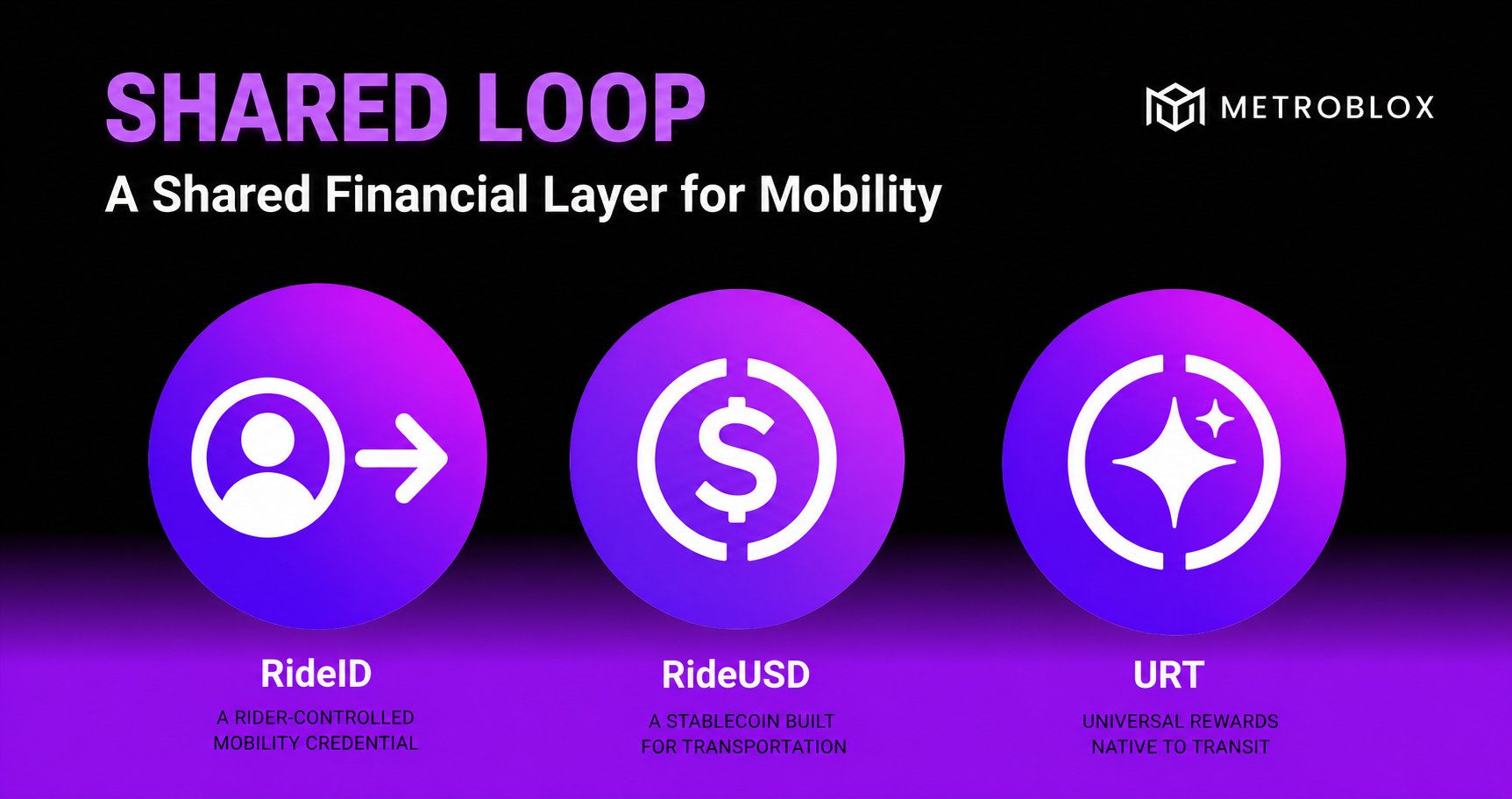
RideID provides a portable mobility identity. It allows riders to connect credentials, preferences, rewards, wallets, and mobility apps.
RideUSD is a U.S. dollar-backed digital settlement asset designed for mobility payments and settlement. It gives operators and partners a faster and more efficient way to settle transportation-related value.
URT, the Universal Ride Token, is a collateralized rewards token used to fund and distribute mobility incentives. URT can be earned for qualifying transportation behavior and redeemed within the Ride Ecosystem.
Together, these components create a shared infrastructure layer for campus mobility.
A university does not need to replace its current transportation systems. Instead, existing systems can connect through APIs, wallets, credentials, and reward rules. The university can define the program, fund the incentive pool, set the reward conditions, and measure the outcomes.
Example: A Campus Mobility Rewards Pilot
A university could launch a 90-day pilot focused on reducing parking demand and supporting student, faculty, and staff mobility.
The pilot might work like this:
The university selects one campus, one group of participants, and one or two transportation behaviors to reward. For example, students may earn rewards when they use a campus shuttle from a remote lot or take transit instead of parking near the center of campus. Faculty and staff may earn rewards for carpooling, taking transit, parking in lower-demand areas, or using an approved shuttle.
Participants sign in with RideID and connect their mobility account. Their existing university ID or campus credential can be mapped to RideID, so the university does not need to issue a second identity system. The university funds a reward pool. Metroblox provides the reward rules, wallet layer, reporting dashboard, and settlement infrastructure.
At the end of the pilot, the university can measure participation, rewarded trips, parking demand changes, transit or shuttle usage, cost per shifted trip, participant feedback, and overall program impact.
The pilot is intentionally simple. It does not require replacing the campus card, parking system, shuttle vendor, transit provider, or commuter benefits platform. It is designed to test whether targeted incentives can improve campus mobility outcomes.
Why This Matters
Campus transportation is no longer just about moving people from one place to another. It touches affordability, sustainability, accessibility, student success, employee satisfaction, land use, and financial operations.
Universities need better tools to coordinate these goals.
The Shared Loop gives campuses a modern way to connect mobility services, fund transportation incentives, and create a better rider experience. It allows universities to start small with a focused pilot, prove value, and expand over time.
A campus does not need one app for everything. It needs a shared layer that helps existing systems work together.
That is the opportunity for the Shared Loop on campus.
The Future of Campus Mobility Is Connected
The next generation of campus transportation will be more flexible, more personalized, and more connected. Students and employees will expect transportation to work the same way other digital services work: simple, portable, and integrated.
The Shared Loop makes that possible.
By connecting identity, payments, rewards, and settlement, Metroblox is helping universities build a more interoperable mobility ecosystem — one that can support students, improve faculty and staff commuter benefits, reduce parking pressure, reward better travel choices, expand accessibility, and prepare campuses for the future of movement.