
Introducing RideUSD
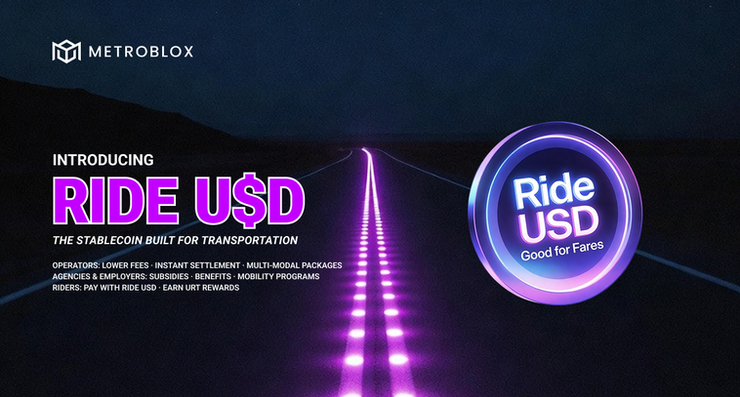
Transportation payments are some of the most frequent transactions in the economy — covering transit fares, parking, tolls, fuel, and everyday mobility services. Yet behind the scenes, most of these payments still settle on legacy financial rails designed decades ago for retail purchases, not high-volume, low-margin mobility.
Today, Metroblox is proud to introduce RideUSD — a USDC-backed digital payment and settlement system purpose-built to modernize how transportation money moves.
RideUSD is built on Solana and fully backed 1:1 by USDC reserves. It delivers predictable low transaction costs, instant settlement, and real-time transparency for operators — while working seamlessly with the systems riders already use.
Why Transportation Payments Need a New Financial Layer
Transportation payments are uniquely challenging:
- Transactions are small but frequent
- Margins are thin
- Fees are disproportionately expensive
- Settlement is slow and fragmented
- Revenue is hard to share across providers
Whether it's a $2 bus fare, a $6 parking session, a $45 fuel purchase, or a toll crossing, operators often lose 2–5% of every transaction to processing fees and wait days to receive funds.
RideUSD fixes this by modernizing the settlement layer, not the rider experience. Operators can continue using existing apps, cards, gates, pumps, meters, and POS systems — while RideUSD works behind the scenes to move value faster and cheaper.
What Is RideUSD?
RideUSD is a stablecoin — a type of digital dollar designed to combine the stability of traditional currency with the speed and efficiency of modern blockchain networks.
Unlike cryptocurrencies that fluctuate in value, a stablecoin is pegged 1:1 to the U.S. dollar and backed by reserves. This means one RideUSD is always worth one U.S. dollar, making it suitable for everyday payments like fares, parking, fuel, and tolls.
Stablecoins have rapidly become one of the most widely used financial technologies in the world because they move value instantly, at extremely low cost, and without intermediaries. In 2025 alone, over $30 trillion in stablecoin transactions were processed globally, driven by their ability to settle payments in seconds instead of days, with fees measured in fractions of a cent. These advantages have already transformed banking settlement, cross-border transfers, and institutional payments.
RideUSD brings those same benefits to transportation — one of the largest everyday payment categories still constrained by legacy settlement systems.
Built on Solana for Speed, Scale, and Cost Efficiency
RideUSD runs on Solana, a high-performance blockchain capable of processing thousands of transactions per second with near-zero fees. This makes it possible to handle transportation-scale payments — something legacy financial rails were never designed to support.
By using Solana's high-speed, low-cost settlement, RideUSD makes everyday mobility settlement economically efficient for operators, while maintaining full transparency and auditability.
RideUSD Is the Value Layer of the Ride Ecosystem
RideUSD is more than a settlement method — it's the foundation of the Ride Ecosystem, a modern financial operating system for transportation.
The Ride Ecosystem unifies:
- Payments (RideUSD)
- Rewards & incentives (Universal Ride Tokens – URT)
- Packaged mobility (multi-operator passes and bundled services)
- Wallets & rider apps (Ride Wallet and SDK)
- Settlement & clearing (RideDEX)
Together, these components create a shared financial layer that connects public and private mobility providers into one interoperable network — enabling real-time settlement, shared incentives, and multi-operator coordination.
How the Ride Ecosystem Benefits Operators
Lower Transaction Costs
RideUSD replaces expensive per-transaction card fees with instant, low-cost settlement — improving margins and cash flow from day one.
New Revenue and Demand
Partners such as employers, cities, and travel platforms can fund rides and rewards using URT, sending new demand directly into operator networks.
Mobility-as-a-Service Made Simple
With unified settlement in place, operators can finally bundle multiple services — transit, parking, micromobility, rideshare, and tolls — into a single mobility product without manual reconciliation.
Fast, Flexible Integration
Operators integrate RideUSD via SDKs, wallets, or cards — without replacing existing hardware or rebuilding infrastructure. New payment and incentive programs can launch in weeks, not years.
Built for the U.S. Regulatory Environment
Recent U.S. legislation, including the GENIUS Act, has established clear requirements for reserve backing, custody, and oversight of stablecoins — creating a compliant framework for using digital dollars like RideUSD in consumer-facing, enterprise, and public-sector transportation systems.
This regulatory clarity enables operators, agencies, and commercial partners to confidently adopt stablecoin-based settlement for everyday transportation payments.
A Financial Operating System for How the World Moves
RideUSD modernizes the financial layer of transportation without disrupting rider access or existing infrastructure. It gives operators the tools to lower costs, unlock new revenue, and coordinate across mobility networks — while giving riders faster, more seamless experiences. This is not about replacing systems. It's about connecting them.