
A Shared Financial Layer for Mobility
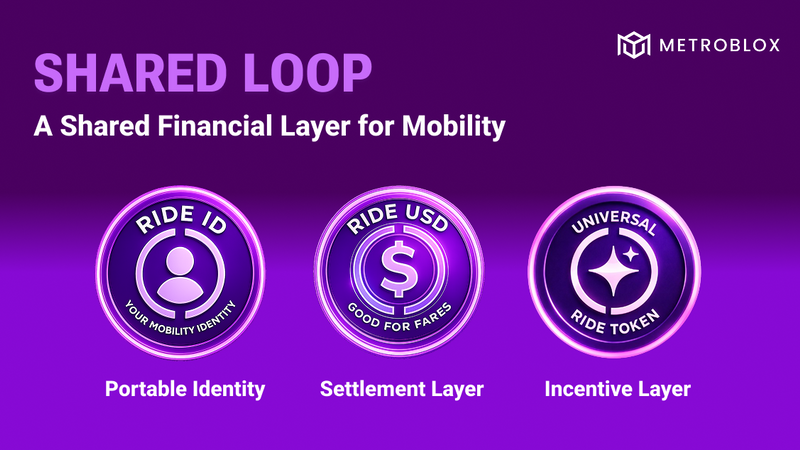
What’s missing from today’s transportation payment systems is not another app or another payment method - it’s a shared financial layer.
Modern mobility remains highly fragmented. Transit agencies, parking operators, tolling systems, rideshare platforms, EV charging networks, and micromobility providers all operate within separate financial and loyalty systems. Payments may work within each service individually, but they rarely work together as a connected ecosystem.
This creates a major limitation for the future of mobility.
Today’s transportation networks struggle to package, bundle, and resell mobility across providers because payments, identity, incentives, and settlement remain siloed. A transit agency cannot easily share incentives with a parking operator. An employer commuter program cannot seamlessly integrate rewards across multiple transportation services. And mobility platforms still rely heavily on legacy payment rails built for retail commerce not for dynamic, multi-provider transportation networks.
The result is friction everywhere:
-
High transaction fees on low-dollar payments
-
Slow settlement cycles
-
Disconnected loyalty programs
-
Limited interoperability between providers
-
Difficulty creating integrated mobility packages
Transportation has modernized operationally, but financially, much of the infrastructure still operates in silos.
That is why the Shared Loop matters.
Metroblox developed the Ride Ecosystem to bring the Shared Loop model to market.
The platform connects mobility identity, payments, settlement, and rewards into one shared financial layer, enabling transportation providers to reduce costs, launch interoperable incentives, and create new mobility packages across transit, parking, tolls, fuel, EV charging, and other services.
The Problem With Today’s Payment Models
For years, transportation has relied on two primary payment models:
closed loop and open loop.
Closed-loop systems give operators more control through proprietary cards and accounts, but they are expensive to maintain and difficult to interoperate across agencies and mobility providers.
Open-loop systems improved convenience by allowing riders to pay with bank cards and mobile wallets, but they introduced another issue: transportation became dependent on legacy banking rails and card network economics.
That works reasonably well for large retail purchases. It works far less efficiently for transportation, where transactions are frequent, small, and increasingly automated.
A $3 transit fare or $5 parking payment can carry disproportionately high processing costs. Settlement may take days. Loyalty programs are fragmented. And every mobility provider operates within its own financial silo.
Shared Loop Introduces a Different Model
Shared Loop is a new model for mobility identity, payments, settlement, and incentives.
Instead of treating transportation payments as isolated transactions between riders and operators, Shared Loop creates a shared financial layer across mobility networks.
The model is built around three core components:
-
Ride ID - a portable mobility credential that allows riders to move across transportation services using a shared identity layer
-
RideUSD - a modern settlement layer designed for low-cost, instant transportation payments
-
URT (Universal Ride Token) - a universal rewards system that allows incentives to move across the mobility ecosystem
Together, these components create a continuous loop where identity, payments, and rewards work together instead of operating independently.
Why This Changes Transportation Economics
Transportation operators face constant pressure from transaction costs, delayed payouts, and customer acquisition expenses. Shared Loop reduces friction at the infrastructure level.
With near-zero processing fees and instant settlement, operators can retain more revenue and improve cash flow. Instead of waiting days for settlement, funds move in real time.
At the same time, rewards become programmable and interoperable. Incentives issued in one part of the mobility ecosystem can be used in another, creating stronger network effects across transportation providers.
A transit rider could earn rewards from commuting and use them for parking, micromobility, or EV charging. Employers, cities, and private operators can all participate in the same incentive infrastructure.
Perhaps most importantly, Shared Loop makes multimodal mobility packaging possible at scale. Transportation providers can bundle and resell mobility services across networks because payments, rewards, and settlement now operate on shared infrastructure rather than isolated systems.
AI and the Rise of Autonomous Commerce
Shared Loop also aligns with where mobility is heading.
As AI-powered systems and connected vehicles become more common, transportation payments will increasingly happen automatically. Cars, transit systems, parking platforms, and digital mobility agents will transact directly with infrastructure in real time.
Legacy payment systems were not designed for machine-to-machine micropayments.
Shared Loop introduces a lightweight financial architecture capable of supporting that future — where payments, incentives, and mobility services interact seamlessly across networks.
A New Financial Layer for Mobility
Transportation is becoming increasingly connected, automated, and digital. But the financial infrastructure supporting it has lagged behind.
Shared Loop represents a shift away from fragmented payment systems toward a shared mobility economy — one where value can move instantly, rewards can circulate across providers, and identity becomes portable across transportation networks.
Just as open-loop payments modernized transit access, Shared Loop has the potential to modernize the financial layer underneath mobility itself.
Invitation to Pilot
Metroblox is currently partnering with forward-thinking transit agencies and mobility operators, as well as solution providers to launch pilot programs.